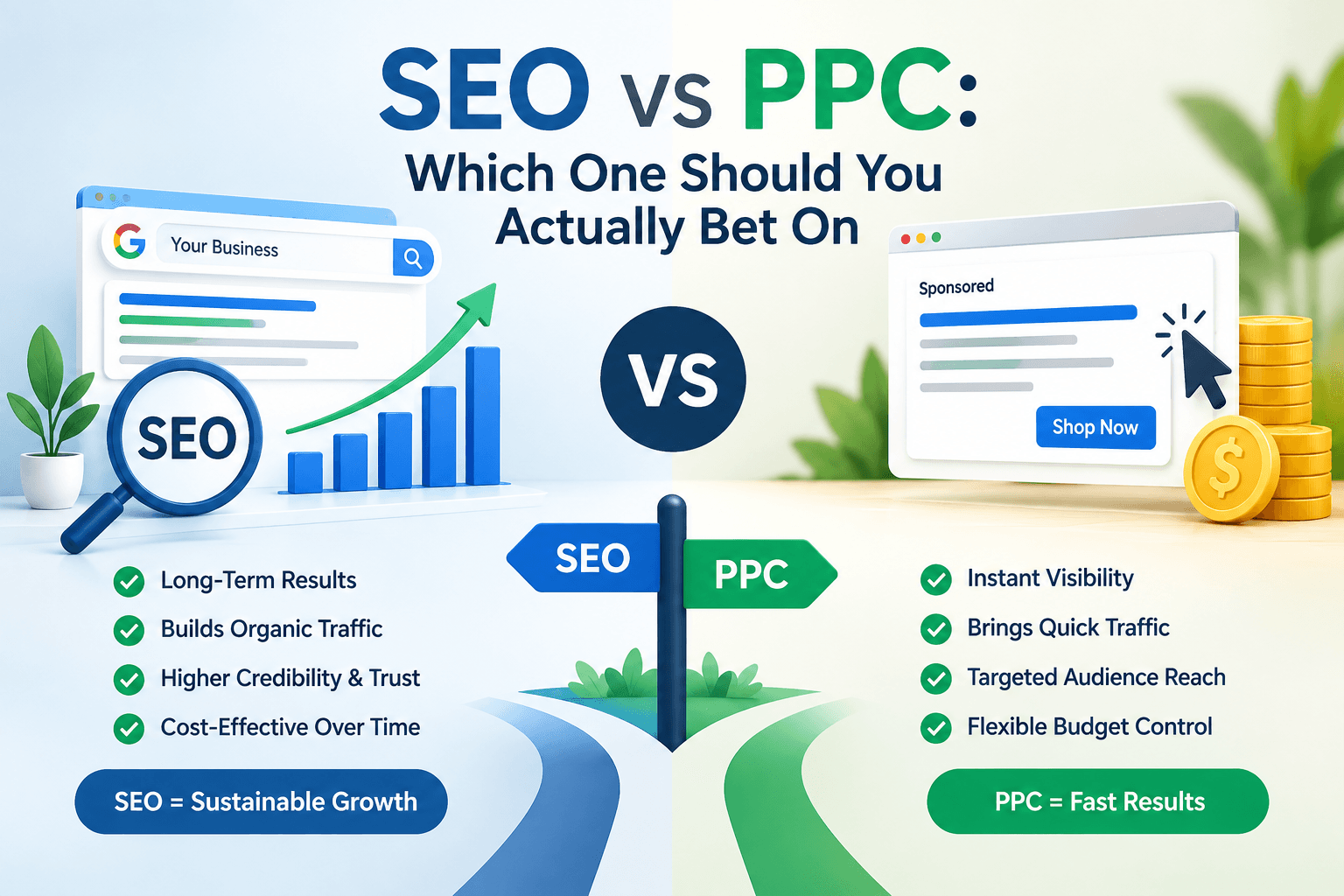
Most growing businesses pour their entire marketing budget into one channel, then wonder why revenue stays flat. The gap usually shows up the same way: an SEO campaign that takes six months to move the needle, or a PPC account bleeding spend on clicks that never convert.
When you stop picking a side and start engineering both channels around actual business goals, the same budget can produce double the qualified leads in half the time. Below is the framework we use with clients deciding between organic and paid growth.
Diagnose the Business Before You Pick a Channel
Map Urgency to Channel, Not Preference
The single biggest mistake founders make is choosing a SEO vs PPC strategy based on what a competitor is doing, not on what their business actually needs right now. If you need revenue inside 30 days, PPC wins that race every time. If you're building a three-year asset that keeps generating leads without a recurring spend, SEO is the better bet.
Clients who ran PPC-only for a full year without touching SEO saw customer acquisition cost climb by 44% as competition in the auction increased. Once we layered in a content and technical SEO base, blended CAC dropped by 31% within five months.
Audit Your Funnel Before Blaming the Channel
Every rupee spent on traffic, organic or paid, is wasted if the landing page underneath it doesn't convert. Pull your last 90 days of sessions, segment by source, and check bounce rate against page load time. Anything over a 3-second load with a bounce rate above 65% needs to be fixed before you spend another paisa on acquisition.
One client was blaming a "bad SEO strategy" for weak leads. The real issue was a 6-second homepage load. After we optimized it, the same organic traffic converted at nearly triple the rate.
Budget Allocation That Mirrors Real Business Stage
Set a Channel Split Based on Runway, Not Guesswork
Early-stage businesses with under six months of cash runway should weight 70-80% toward PPC for immediate pipeline, and the remainder toward foundational SEO work like technical fixes and core page content. Businesses with more runway can flip that ratio as organic rankings start compounding.
Weeks 1-8: heavy PPC testing to learn what messaging converts
Weeks 8-20: begin building SEO content around the keywords that already prove intent from paid data
Month 6 onward: shift spend gradually as organic traffic starts covering pipeline volume
A client following this exact sequence cut their blended cost per lead from ₹1,850 to ₹960 within two quarters, without increasing total ad spend.
Don't Split a Small Budget Too Thin
If your monthly marketing budget is under ₹50,000, running both channels at once often means neither gets enough investment to actually work. It's usually smarter to go deep on one digital marketing strategy for business growth, get it profitable, then reinvest the returns into the second channel.
Content and Creative: The Layer Both Channels Depend On
Reuse High-Intent PPC Data to Fuel SEO Content
Your paid search terms report is a goldmine most teams ignore once the campaign is live. Pull the exact queries triggering conversions and build long-form content around those same terms. This shortens the SEO content research cycle dramatically because you already know the phrases that drive buyer intent.
A B2B client used this method to identify 40 converting search terms from PPC data, then built pillar content around the top 12. Nine of those pages ranked in the top 5 organic positions within four months.
Keep Messaging Consistent Across Both Channels
Prospects who click a paid ad and later find your organic listing expect the same value proposition. Mismatched messaging between your ad copy and your ranking page content quietly kills trust and tanks conversion rate, even when both channels individually look "healthy" in reporting.
Scale With the Right Infrastructure Behind You
A strong channel decision still stalls without the operational backbone to execute both sides well. Teams that pair performance SEO services with disciplined PPC management tend to avoid the whiplash of chasing whichever channel had a good month.
If you're weighing this decision for your own business and want a second opinion on where your budget should actually go, our team at growthservice puts together a channel-by-channel growth plan based on your runway, margins, and current funnel data, not a generic template.
For businesses further along that are ready to run both channels together under one strategy, growthservice also handles the full execution loop, from technical SEO audits to live bid management, so nothing falls through the cracks between teams.
Strategic Takeaway
There's no universal winner between SEO and PPC. The right call depends on your runway, your margins, and how fast you genuinely need revenue to show up. Treat both channels as parts of the same system rather than competitors for the same budget line. Audit the funnel first, match spend to business stage, and let paid data inform organic content instead of running both in silos. That's how the same budget starts producing double the qualified pipeline.